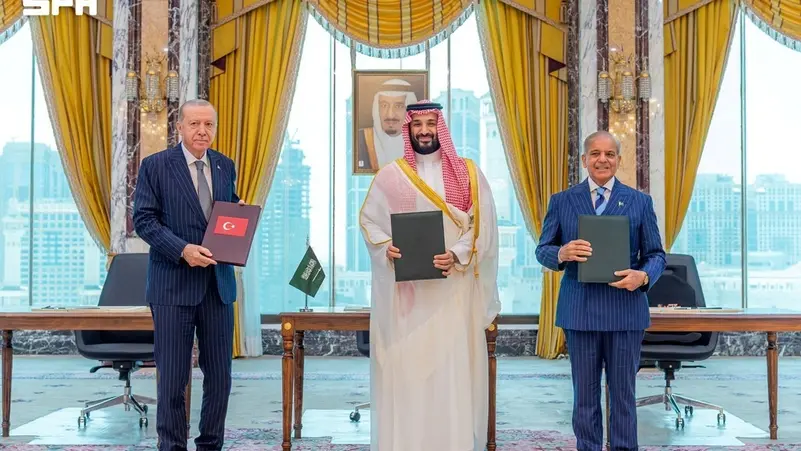
Saudi Arabia, Pakistan and Turkey have signed a landmark collective-defence agreement in Mecca, committing the three countries to treat an attack against any one of them as an attack against all.
Saudi Crown Prince and Prime Minister Mohammed bin Salman, Pakistani Prime Minister Shehbaz Sharif and Turkish President Recep Tayyip Erdogan signed the accord on Friday. The agreement has been formally named the Mecca Joint Defense Agreement.
The pact is intended to strengthen deterrence, improve coordination and support the development of the three countries’ respective defence capabilities. Saudi officials have emphasised, however, that it should not be interpreted as the creation of a new military axis, a sectarian alliance or a nuclear arrangement.
What the Collective-Defence Clause Means
The central feature of the agreement is its collective-defence principle. Under this framework, aggression against one signatory will be regarded as aggression against all three.
In practical terms, the clause sends a political signal that Saudi Arabia, Pakistan and Turkey intend to coordinate their responses to major external security threats. It may also strengthen deterrence by raising the potential cost of an attack against any of the three states.
The publicly available information does not yet specify what form a joint response would take in every scenario. It therefore remains unclear whether assistance would automatically involve military action, logistical support, intelligence cooperation, diplomatic measures or a combination of responses. Further implementation arrangements may provide greater clarity.
Agreement Aims to Integrate Defence Capabilities
Saudi Deputy Minister for Public Diplomacy Dr. Rayed Krimly said the agreement would allow the signatories to further develop and integrate their defence capabilities.
The three countries bring different strengths to the partnership. Saudi Arabia has significant economic resources and a central position in Gulf security. Turkey possesses one of NATO’s largest armed forces and a rapidly expanding defence industry. Pakistan contributes extensive military experience and long-standing defence relationships with both Riyadh and Ankara.
Closer cooperation could potentially include joint exercises, military training, defence-industrial projects, intelligence coordination and the development of compatible systems. However, the complete operational scope of the agreement has not yet been made public.
Saudi Arabia Rejects Claims of a New Military Bloc
Saudi officials have sought to limit speculation about the pact’s wider purpose. Krimly said it was not designed to establish a new military axis or a sectarian coalition.
He also rejected suggestions that the agreement was connected to nuclear ambitions or a regional arms race. The statement is important because Pakistan is a nuclear-armed state, while debates surrounding defence cooperation in the Middle East can quickly generate speculation about extended nuclear guarantees. No such commitment has been announced as part of the Mecca agreement.
Riyadh has also stressed that the arrangement is not directed against any country and does not represent an attempt to escalate tensions between regional states.
Existing Partnerships Will Remain in Place
The new trilateral pact will not replace the signatories’ existing bilateral or multilateral commitments, according to the Saudi explanation.
This means Turkey’s responsibilities as a NATO member remain separate from the Mecca agreement. Pakistan and Saudi Arabia’s existing defence relationship also continues, including the Strategic Mutual Defence Agreement signed by Islamabad and Riyadh in September 2025.
Saudi Arabia has additionally indicated that the new pact will not come at the expense of its close relations with Gulf, Arab or international partners. The Kingdom appears to be presenting the agreement as an additional security framework rather than a substitute for its established alliances and partnerships.
Why the Mecca Agreement Is Significant
The accord brings together three of the Muslim world’s most influential states at a time of increased uncertainty across the Middle East.
Regional governments are dealing with military conflict, attacks on infrastructure, threats to commercial shipping and questions about the future reliability of traditional security arrangements. These pressures have encouraged regional and middle powers to explore closer coordination and greater defence self-reliance.
Abdulaziz Sager, chairman of the Gulf Research Center, described the meeting as evidence of a growing willingness among regional powers to cooperate more closely on security matters.
The agreement could consequently have an impact beyond the three signatories. It may influence regional deterrence calculations, defence procurement and future security partnerships involving Gulf and Muslim-majority countries.
What Comes Next
Attention will now turn to how the Mecca Joint Defense Agreement is implemented.
Key questions include whether the three countries will establish a permanent coordination mechanism, expand joint military exercises, launch new defence-industry projects or define specific procedures for responding to an attack.
The answers will determine whether the agreement remains primarily a powerful political commitment or develops into a deeply integrated security framework. For now, its immediate message is clear: Saudi Arabia, Pakistan and Turkey want closer collective defence coordination while avoiding the appearance of an offensive or exclusionary military alliance.