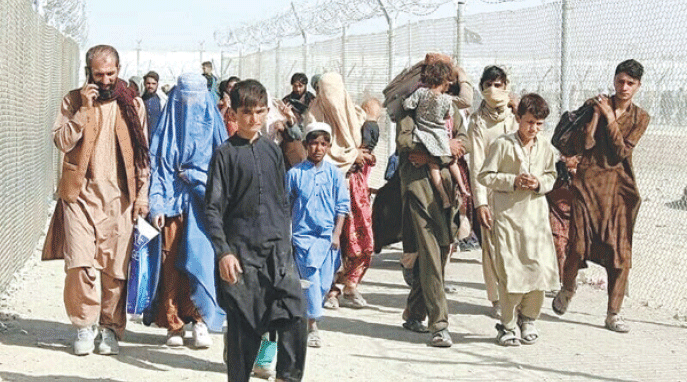
Afghan refugees awaiting US resettlement under the P1/P2 programme have appealed to the Trump administration to immediately restart evacuations, warning that they face extreme hardship and increasing risks of deportation from Pakistan.
ISLAMABAD: Afghan refugees waiting for resettlement in the United States under the P1/P2 programme have urged the Trump administration to urgently resume evacuations, saying they are living in Pakistan under severe hardship and constant fear of detention and deportation.
The appeal came days after Washington suspended all Afghan immigration processing indefinitely following the shooting of two National Guard soldiers near the White House.
In a statement shared with the media, the Afghan P1/P2 case holders expressed shock over the sudden halt.
“Our cases were fully processed, and we were only waiting for our flight dates when, on January 20, 2025, the programme was suspended without explanation,” the statement said.
They condemned the Washington attack, stressing that the act of a lone individual should not punish thousands of Afghans who served the US at great personal risk.
“This was the act of a single person. It must never be used to collectively punish loyal Afghan allies,” they said.
As tensions rise between Pakistan and Afghanistan due to cross-border militancy, Islamabad has intensified deportations. Refugees claim even those with valid documents and official US Embassy letters are being detained.
“Even official letters carry no protection,” the statement noted. “If deported to Afghanistan, we will be identified and killed by the Taliban for serving the United States.”
The group urged the Trump administration to uphold its commitments and restart the evacuation process immediately.
“We are not criminals. We are the allies who stood with America. Now, we ask America to stand with us,” the statement read.
The UNHCR also voiced concern, urging Pakistan to exempt vulnerable Afghans from the Illegal Foreigner Repatriation Plan.
According to UNHCR, more than one million Afghans have returned from Pakistan to Afghanistan in 2025 alone.
“Under current conditions, this raises more concerns than solutions,” said UNHCR representative Philippa Candler.