Armed clashes between Thai and Cambodian forces continued early Saturday, only hours after US President Donald Trump said both countries had agreed to halt hostilities.
Thailand’s Prime Minister Anutin Charnvirakul stated that he informed the US president a ceasefire could only be considered if Cambodian forces fully withdrew from disputed areas and landmines were removed from the border region.
“Thailand will continue its military operations until there is no longer any threat to our territory or our people,” Anutin said in a social media statement, adding that recent military actions clearly demonstrated Thailand’s position.
Overnight shelling was reported as Thai troops attempted to secure strategic positions along the border. The renewed fighting has resulted in at least 21 deaths, while approximately 700,000 civilians have been displaced on both sides of the frontier.
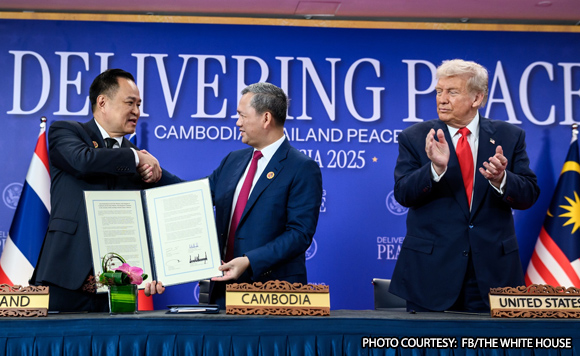
Earlier in the week, Trump claimed he could end the conflict simply through direct talks. Following phone conversations with both leaders on Friday, he posted online that Thailand and Cambodia had agreed to stop all firing and return to the ceasefire framework signed in October under US mediation.
“Both sides are ready for peace,” Trump wrote.
However, the Thai prime minister later said Thailand was not responsible for starting the conflict and insisted Cambodia must first prove that its forces had withdrawn and landmines cleared before any ceasefire could take effect.
Cambodia, meanwhile, reported fresh Thai air strikes on Saturday. According to Cambodia’s defence ministry, Thai F-16 fighter jets carried out bombing runs on multiple targets, claiming the air attacks had not yet stopped.
Thailand’s military confirmed that clashes were ongoing.
The latest escalation stems from a long-running border dispute, which intensified again on 24 July when Cambodia allegedly fired rockets into Thai territory, prompting Thai air strikes in response. Both nations continue to accuse each other of initiating the violence.
After several days of heavy fighting earlier this year, which left dozens dead, both sides agreed to an “immediate and unconditional ceasefire” brokered by international mediation in October. Despite this agreement, both governments have since accused one another of violating its terms.
Thailand has presented evidence alleging Cambodian forces laid new landmines along the border, injuring several Thai soldiers. Cambodia has rejected these claims, arguing the mines date back to its civil war in the 1980s.
Tensions have continued to rise in recent weeks. Thailand launched air strikes inside Cambodia after two Thai soldiers were wounded in a border skirmish, while Cambodia responded with rocket attacks. The violence has affected multiple provinces in northeastern Thailand and northern Cambodia.
Thailand and Cambodia have disputed their 800-kilometre land border for more than a century. The boundary was originally drawn in 1907 during the period of French colonial rule in Cambodia, and remains a source of recurring tension.