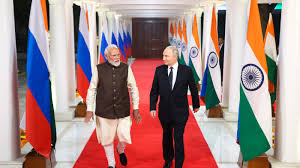
NEW DELHI – Russian President Vladimir Putin has criticised the United States for imposing new tariffs on India over its purchase of Russian oil, calling it a clear example of double standards. He pointed out that while Washington continues to buy nuclear fuel and uranium from Russia, it objects to New Delhi maintaining its own energy relationship with Moscow.
Putin said Russia is open to discussing the matter with US President Donald Trump, but stressed that India has every right to make independent energy decisions based on its national interest.
Recently, Trump accused India of indirectly supporting Russia’s war in Ukraine by importing Russian oil, and in response, imposed an additional 25% tariff on several Indian goods entering the US market.
Rejecting this narrative, Putin maintained that Russia and India had established strong and effective energy cooperation long before the Ukraine conflict. He added that neither he nor Indian Prime Minister Narendra Modi has ever used bilateral ties to undermine or target any other country. According to him, Trump’s tariff decision may reflect his own political considerations rather than ground realities.
Despite global tensions and the ongoing Ukraine conflict, Putin underlined that the Russia-India energy partnership remains stable, functional, and mutually beneficial. He also reaffirmed that the relationship between the two nations continues on the principles of trust, respect, and strategic cooperation.
Putin made these comments during an interview with India Today, shortly before arriving in New Delhi for a two-day state visit to attend the 23rd India-Russia Annual Summit.
Prime Minister Modi received President Putin at Palam Airport, breaking protocol to personally welcome his “friend.” The two leaders shared a warm handshake and hugged before leaving for 7 Lok Kalyan Marg, where Modi hosted a private dinner for the Russian President.
During his 30-hour visit, Putin will hold high-level talks, attend the annual summit, meet business leaders, and review major agreements in defence, nuclear energy, technology, trade, space, and strategic cooperation.