Summary
- The IAF did not attack all the known Iranian ballistic missile bases within range of Israel at the outset of its campaign
- The IAF has also dissipated its effort to suppress Iran’s ability to retaliate by hitting targets that do not represent an immediate threat
There have been curious aspects to the Israeli Air Force’s (IAF’s) campaign to suppress Iran’s ballistic missile capability – the primary threat to Israel – since it began Operation ‘Rising Lion’ on 13 June, with some bases at least initially left un-attacked, while seemingly less-essential targets have been hit.
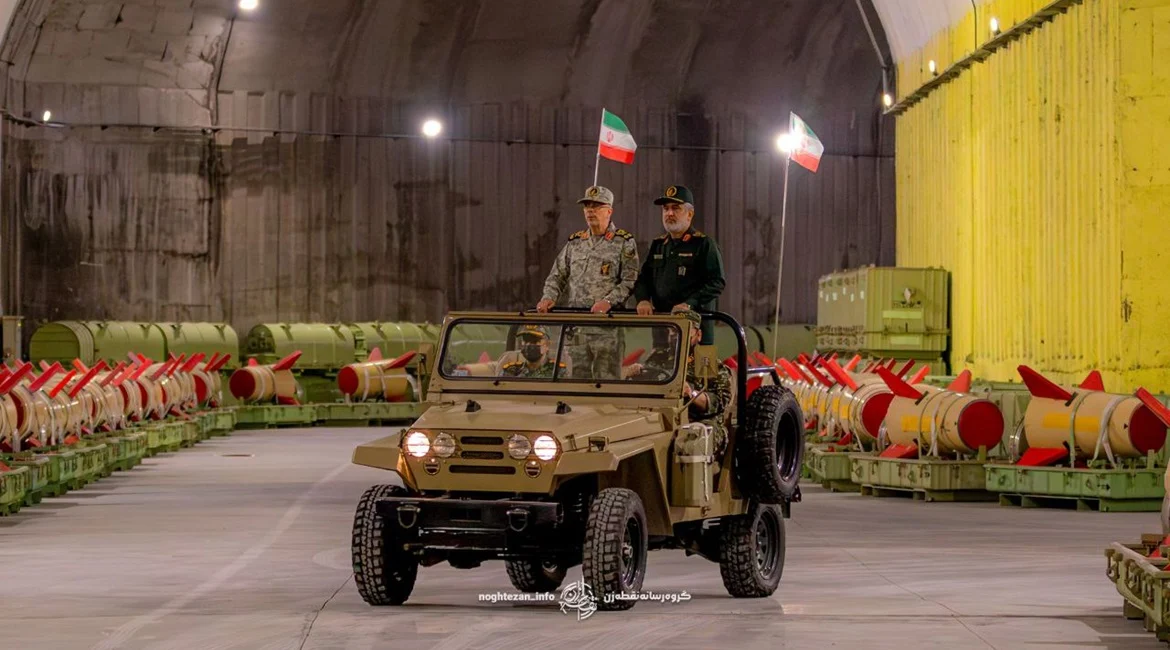
The most obvious way of reducing the threat is to attack the missile bases, which are typically built in mountain valleys and have tunnels and bunkers where transporter-erector-launchers (TELs) and missiles are stored. The bases in western Iran would likely be prioritised over those further east as they can reach Tel Aviv using Iran’s large arsenal of missiles with ranges of between 1,200 and 1,400 km.
Airstrikes against several such bases have been confirmed, including ones near Kermanshah, Khorramabad, and Tabriz.
Maxar satellite imagery from 15 June shows the base just to the east of Kermanshah city and about 1,300 km from Tel Aviv was heavily hit, with numerous buildings destroyed. The buildings included the three large sheds where TELs can erect their missiles into the launch position for maintenance and training. The IAF is presumably targeting them in case they contain TELs.
It also appears that the entrances to some, but not all the tunnels and bunkers, were targeted using guided munitions coming in at angles, not destroyed from above using penetrator bombs, raising the possibility that the damage can be cleared, enabling any TELs trapped inside to deploy.
This might reflect the limited payloads that Israeli aircraft can carry to Iran, given the IAF has not received its new KC-46 aerial refuelling aircraft yet, leaving it reliant on its old 707 tankers. In this context, it probably makes sense to arm a strike aircraft with eight 250 lb GBU-53/B glide bombs that can temporarily damage tunnel entrances rather than a single 2,000 lb penetrator.
Satellite imagery shows less damage at other missile bases. For example, all the TEL sheds at one of the two Bidkaneh bases southwest of Tehran and about 1,500 km from Tel Aviv were hit, but the tunnel entrances do not appear to have been attacked. A fire was visible at the missile base south of Shiraz in imagery from 15 June, but the buildings were undamaged.
Other bases remained intact after the initial wave of strikes, including the second Bidkaneh facility and the one north of Shiraz.
A video released by the Israel Defense Forces (IDF) on 13 June was also curious as it included aerial targeting footage of a 9P117 TEL being destroyed. This type was acquired by Iran in the 1980s and can only be used to launch ‘Scud’-type missiles, which do not have the range to reach Israel. This promoted speculation that the IAF accidentally targeted one of the 9P117s that have been left in the open at the Khorramabad missile base, about 1,300 km from Tel Aviv.
On the following day, the IDF released a video showing a missile base that it said had been attacked, which could be identified as Khorramabad. Using computer graphics, the video showed how some of the tunnels are used to store TELs and missiles, while another underground area has portals in a steep southwest-facing slope through which missiles can be launched. Satellite imagery confirmed the base has been attacked although it is unclear if the tunnels have been destroyed. The launch portals shown by the IDF are not visible in satellite imagery.
The IAF has also targeted Iran’s missile production facilities, strikes that are unlikely to have any impact on the current battle but will slow Iran’s ability to rebuild its stockpiles. The IDF released images of this target set on 15 June, enabling one identified as a navigation systems production facility to be identified as Shiraz Electronics Industries, Iran’s radar manufacturer.
IRIAF grounded
Iran’s air defences have been heavily targeted from the outset of Operation ‘Rising Lion’ to enable IAF aircraft to operate more freely in Iranian airspace. However, the extent to which the IAF has also targeted the Islamic Republic of Iran Air Force (IRIAF) is surprising as most of its fighters entered service before the 1979 revolution and are not considered a significant threat.
The IDF announced on 13 June that it had destroyed the airbase at Tabriz, which hosts a mix of MiG-29 and F-5 fighters. Satellite imagery shows some aircraft shelters were hit, and bombs hit the northern runway and the taxiway that connects the IRIAF base with the runways, which are also used by the city’s international airport. Satellite imagery showed similar damage at Hamadan airbase, where most of the shelters used by the F-4 fighters were penetrated by bombs from above.
On 16 June the IDF released a video showing two F-14 fighters being destroyed at the airbase next to Tehran’s Mehrabad International Airport. While the IDF said the F-14s were prepared to intercept Israeli aircraft, there was speculation it bombed two unserviceable jets that were left outside the hardened air shelters at the base. The F-14s have symbolic value, as Iran’s ability to keep them flying for 45 years without US support is impressive.
Numbers game
The IDF has said the campaign against Iran’s ballistic missile capabilities is going well, with spokesperson Brigadier General Effie Defrin saying during a 16 June briefing that more than 120 TELs had been destroyed overnight, which represented a third of Iran’s launchers. He said the 65 ballistic missiles that were launched in two barrages overnight were half the number the Iranians were planning to launch. He acknowledged that four of those missiles had got through Israel’s air defences, killing eight people and injuring many more.
In his briefing on the following day, Brig Gen Defrin said about 30 ballistic missiles were launched overnight, several of which impacted. Also in a 17 June briefing, an Israeli military official said more than a third of Iranian TELs have been destroyed throughout the campaign, not just on the night of 15–16 June. He also noted that the three barrages launched the previous night had been the least impactful in Iran’s retaliatory campaign, which has involved around 400 launches so far