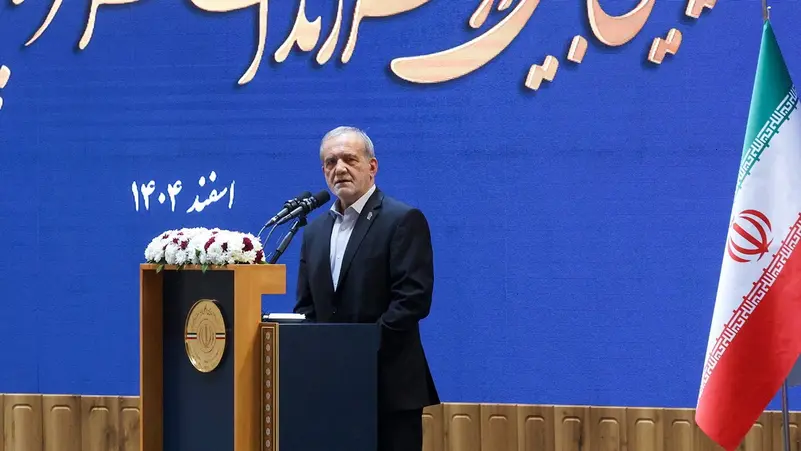
Iran’s President Masoud Pezeshkian declared on Saturday that Iran will not surrender to pressure from Israel and the United States, as the ongoing conflict in the Middle East enters its second week.
In a televised speech broadcast on state television, Pezeshkian strongly rejected calls for Iran’s unconditional surrender, saying that the Iranian people would continue to resist external pressure.
“Our enemies must take their wish for the unconditional surrender of the Iranian people to their graves,” he stated during the address.
The conflict intensified after Israel and the United States launched strikes on Iran on February 28, an operation that reportedly resulted in the death of Iran’s Supreme Leader Ali Khamenei. The attack triggered a wider regional confrontation.
Following the strikes, Iran responded with missile and drone attacks targeting Israel and U.S. interests across the region, particularly in Gulf countries where American military facilities are located.
After Khamenei’s death, Iran established an interim leadership council to oversee the country’s affairs. Pezeshkian is one of the three members currently leading the council.
Despite the strong stance against Israel and the United States, the Iranian president also attempted to ease tensions with neighboring countries. During his speech, he apologized to regional states affected by Iranian strikes.
“I must apologize on my own behalf and on behalf of Iran to the neighboring countries that were attacked,” Pezeshkian said.
He added that the interim leadership council has decided to suspend attacks on neighboring countries, unless attacks against Iran originate from their territories.
“The council agreed that no more attacks will be made on neighboring countries and no missiles will be launched unless an attack on Iran comes from those countries,” he explained.
The statement signals an attempt by Iranian leadership to prevent the conflict from spreading further across the region, while maintaining a firm stance against Israel and the United States.
Observers say the situation remains highly volatile as diplomatic efforts to de-escalate tensions continue.