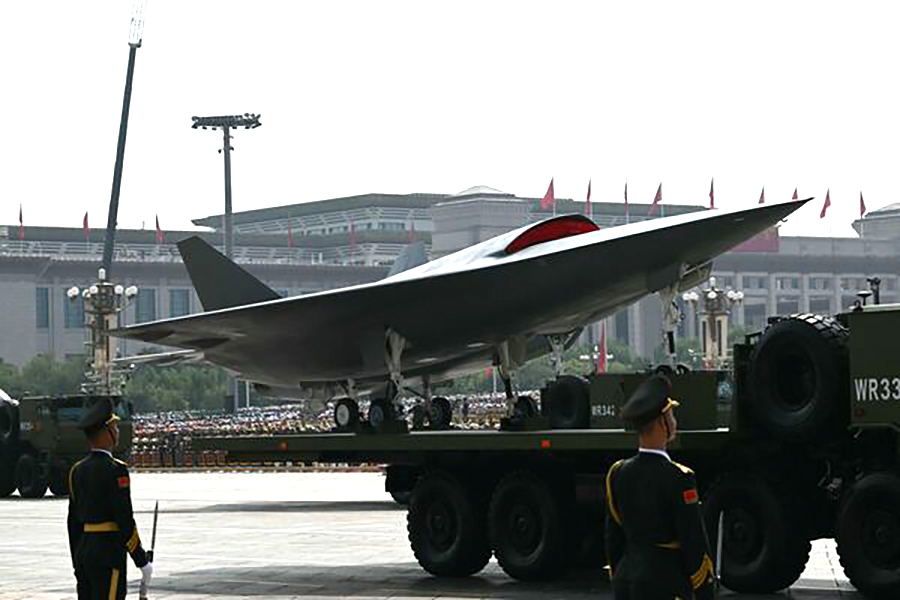
China unveiled new anti-ship missiles, upgraded long-range missiles, a submarine-launched JL-3 missile, and new laser and underwater systems during a major parade. These developments strengthen its defence posture and increase its power in the Indo-Pacific region.
On 3 September, China’s People’s Liberation Army (PLA) revealed a wide range of new weapon systems during a major military parade in Beijing marking the 80th anniversary of the end of World War II.
The parade, held on Chang’an Avenue and attended by President Xi Jinping, displayed advanced equipment from all branches of the PLA — including the air force, ground forces, and rocket force.
Key highlights included major strategic weapons such as the DF-61 intercontinental ballistic missile (ICBM) and the DF-31BJ ICBM, an upgraded version of the earlier DF-31 system. These additions underline China’s continued focus on enhancing its long-range nuclear and conventional deterrence.
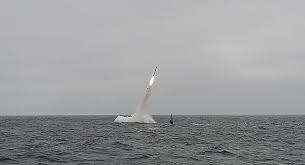
The event also showcased the JL-3 submarine-launched ballistic missile, strengthening China’s sea-based second-strike capability and expanding its nuclear deterrent across multiple domains.
While these major systems drew significant attention, the parade quietly introduced a new generation of anti-ship missiles designed for greater range, speed, and precision. Analysts believe these new missiles significantly boost China’s ability to counter rival naval forces in the Indo-Pacific region.
Alongside missile developments, the PLA unveiled a laser-based weapon and a new unmanned underwater system, both of which signal Beijing’s push toward advanced and disruptive technologies. Experts say these platforms could complicate the operational planning of China’s regional competitors.
Overall, the parade highlighted China’s rapid military modernization and its growing focus on enhancing anti-access and area-denial (A2/AD) capabilities across the Indo-Pacific region.
YJ-15
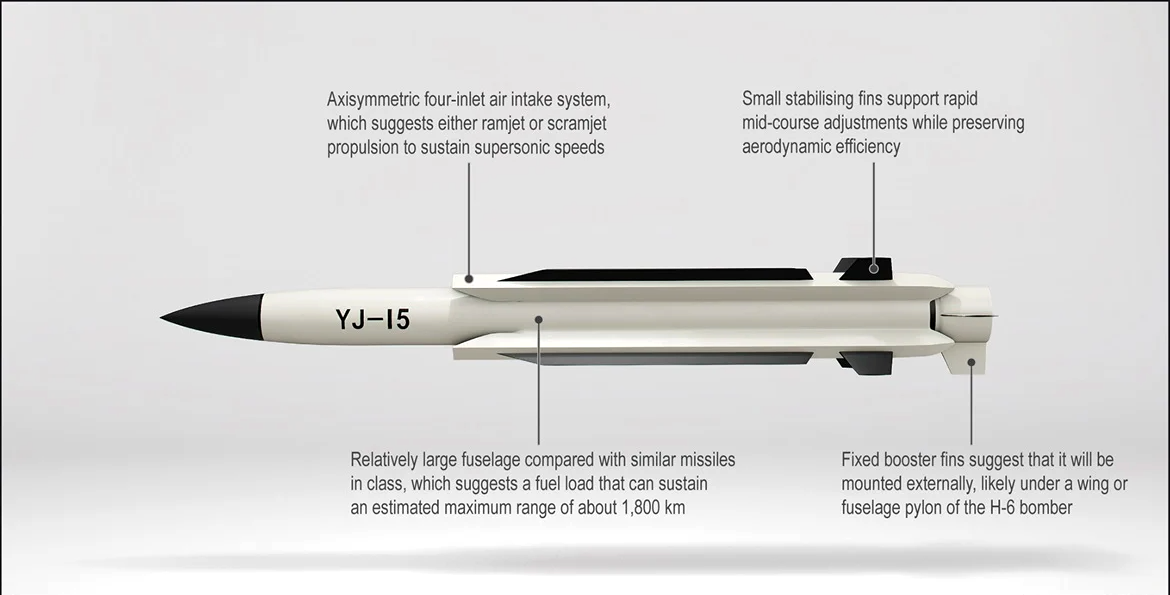
China’s YJ-15 anti-ship missile has been designed to sustain high-speed flight while minimising drag
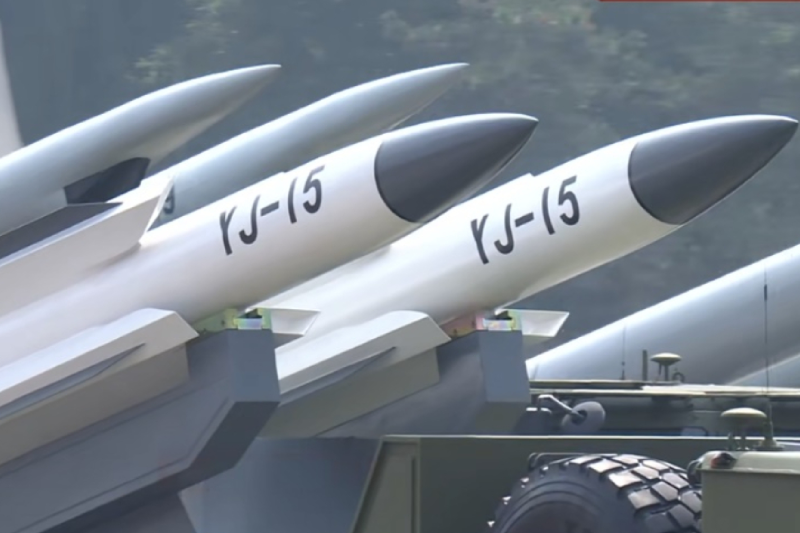
China unveiled a new long-range anti-ship missile, known as the YJ-15, during its recent military parade—highlighting a major upgrade in the country’s maritime strike capabilities. The missile appears to combine extremely high speeds with extended operational range, giving it the ability to overcome traditional naval defences such as close-in weapon systems (CIWS).
The YJ-15 is believed to use a ramjet propulsion system, supported by a circular four-inlet air intake and a sleek, streamlined body. This aerodynamic design reduces drag and allows the missile to maintain sustained high-speed flight.
Early assessments suggest the missile measures about 6.5 metres in length with a 0.5-metre diameter, and likely weighs around 1,500 kg, carrying a 200 kg warhead. Its compact stabilising fins and overall structure indicate that the missile is shaped for manoeuvrability during mid-course flight, without needing large deployable wings.
Considering its propulsion and size, analysts estimate the YJ-15 can reach speeds above Mach 5, with a possible range between 1,200 km and 1,800 km — placing it among the longest-reach anti-ship missiles in service today.
The missile is expected to be air-launched, most likely from the H-6 bomber fleet operated by the PLA Air Force. The aircraft’s reinforced pylons and long-range strike mission make it well-suited to carry such a weapon. Air-launch capability also provides added flexibility, allowing bombers to take off from secure bases while striking targets deep inside contested waters.
Operationally, the YJ-15 is likely designed to hit high-value naval assets, including aircraft carriers and major surface vessels. Its extremely high speed and ability to perform evasive movements during the terminal phase sharply reduce the reaction time available to enemy defences, making interception significantly harder.
Although primarily intended for maritime missions, its performance profile indicates the missile could also be adapted for a secondary land-attack role.
The introduction of the YJ-15 reinforces China’s focus on expanding its anti-access/area-denial (A2/AD) strategy in the Indo-Pacific. By deploying a missile that blends long range, speed, and flexible launch options, China enhances its ability to challenge carrier strike groups and shape the strategic balance across the region.
YJ-17
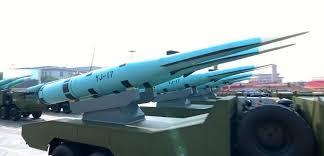
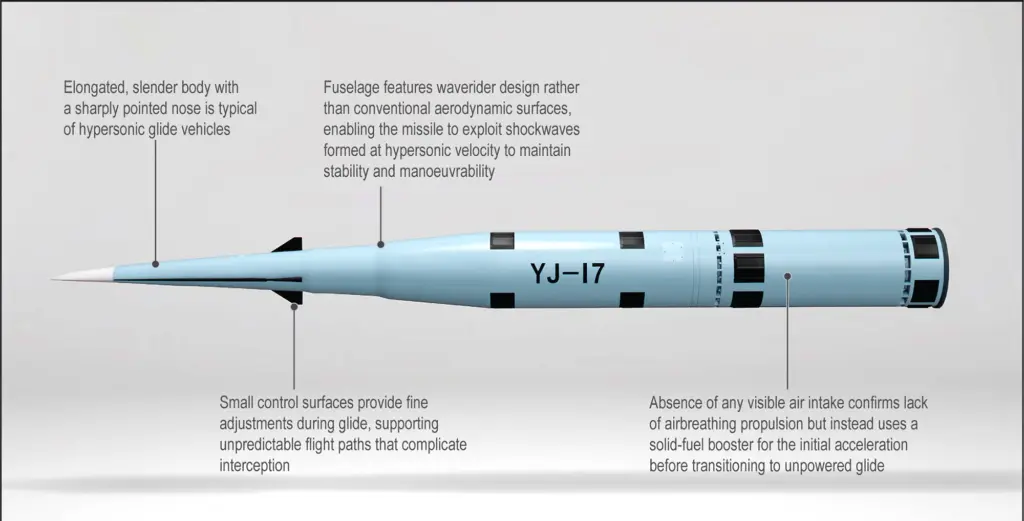
The YJ-17 missile features a long, needle-shaped nose section designed specifically to cut wave drag and lower heat buildup during hypersonic travel and atmospheric re-entry. Its sharply tapered front helps maintain smooth airflow at extreme speeds, improving both stability and aerodynamic efficiency.
One notable aspect of the design is the absence of any air intake, confirming that the missile does not use scramjet propulsion. Instead, it likely employs a solid-fuel booster to achieve the required launch velocity before transitioning into an unpowered hypersonic glide. This profile is typical of boost-glide systems, which rely on altitude and high initial speed to cover long distances.
The YJ-17 is estimated to be around 9 metres in length with a diameter of roughly 0.5 metres. Its clean, uninterrupted fuselage reduces drag and also helps keep its radar signature low. Based on its shape and construction, the missile is expected to reach speeds between Mach 5 and Mach 8.
Unlike traditional cruise missiles that deploy large wings for lift, the YJ-17 appears to follow a waverider-style configuration. At hypersonic speeds, the missile generates lift from the shockwaves forming along its underside, allowing it to maintain high velocity while still being able to manoeuvre. Small control surfaces near the rear of the warhead provide subtle steering in the glide phase, enabling side-to-side movements and skip-glide patterns that make tracking and interception extremely difficult.
To survive the intense temperatures associated with hypersonic flight, the missile is likely constructed using heat-resistant composite materials and ablative coatings.
Its dimensions suggest that the YJ-17 can be integrated with vertical launch systems (VLS) on larger Chinese warships, such as the Type 055 destroyers, while also being compatible with the external hardpoints of H-6 bomber aircraft. This dual deployment option aligns with China’s broader strategy of maintaining flexible, multi-platform strike capability.
Operationally, the YJ-17 appears designed to deliver high-precision strikes against heavily defended, high-value naval assets, including major warships, amphibious platforms, and aircraft carriers. Its speed, manoeuvrability, and flight profile significantly complicate defensive interception and enhance China’s ability to project power across contested maritime regions.
YJ-19
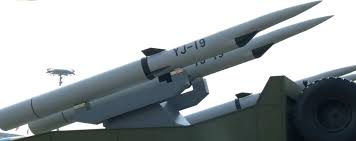
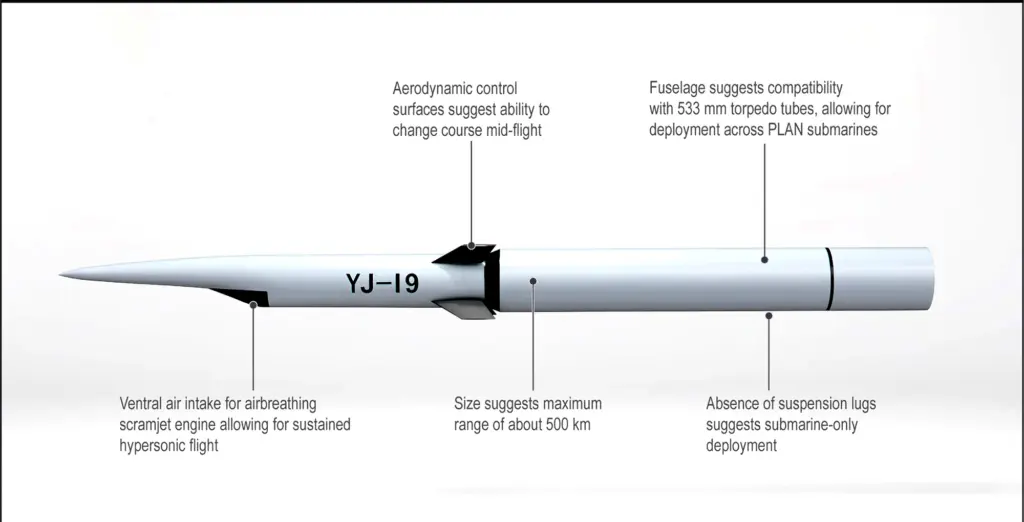
China’s YJ-19 anti-ship missile stands out among the newly displayed systems, largely due to its unusual shape and the absence of comparable designs in China’s current inventory. With an estimated length of around 6 metres and a diameter of roughly 533 mm, the missile appears to be tailored specifically for launch from standard submarine torpedo tubes.
Its most striking feature is the nose section, which seems purpose-built to support a scramjet intake while still maintaining a clean, aerodynamically refined profile for hypersonic flight. Instead of the sharp or ogival nose cones typically used to reduce drag, the YJ-19 incorporates a slightly rounded, integrated intake arrangement that channels airflow directly into the scramjet. This suggests careful optimisation to balance air compression, stability, and speed.
The missile’s estimated weight is about 2,000 kg including the warhead. Based on its dimensions and design characteristics, the YJ-19 is believed to be capable of reaching speeds between Mach 5 and Mach 10, with an operational range of roughly 500 km.
At the heart of the YJ-19 is its scramjet propulsion system, which appears to prioritise sustained hypersonic velocity while managing fuel efficiency. Its streamlined body and ventral intake are consistent with established hypersonic design principles, and the small stabilising fins at the rear likely provide the manoeuvrability required for mid-course adjustments.
These physical traits strongly indicate that the YJ-19 is intended to serve as a submarine-launched hypersonic missile, giving the PLAN a potent strike capability that leverages the stealth of underwater platforms. Its compatibility with 533 mm torpedo tubes means it could eventually be integrated across China’s existing submarine fleet without major structural modifications.
Operational deployment will likely prioritise regions such as the South China Sea and the Western Pacific—areas where underwater stealth and rapid-strike capability can influence control of crucial maritime routes. By launching from beneath the surface and accelerating to hypersonic speed, the YJ-19 drastically reduces an adversary’s warning and reaction time. This combination makes interception significantly more difficult and poses a serious threat to high-value naval assets, including carrier strike groups.
The YJ-19’s appearance also highlights China’s advancing hypersonic development. Alongside systems such as the ship- and air-launched YJ-21 and the DF-17 land-based missile, the YJ-19 reflects a broader strategy aimed at establishing a layered maritime strike network combining ballistic and hypersonic cruise capabilities.
YJ-20
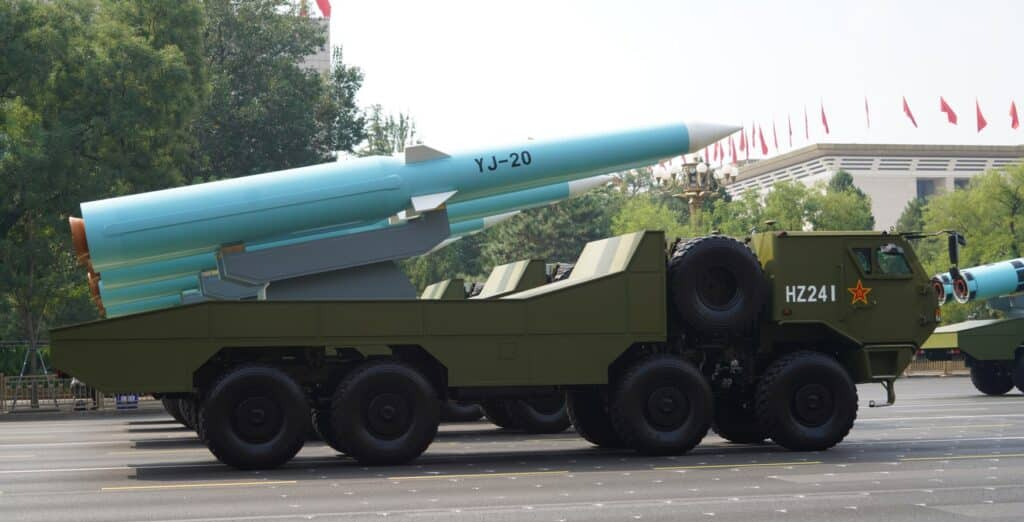
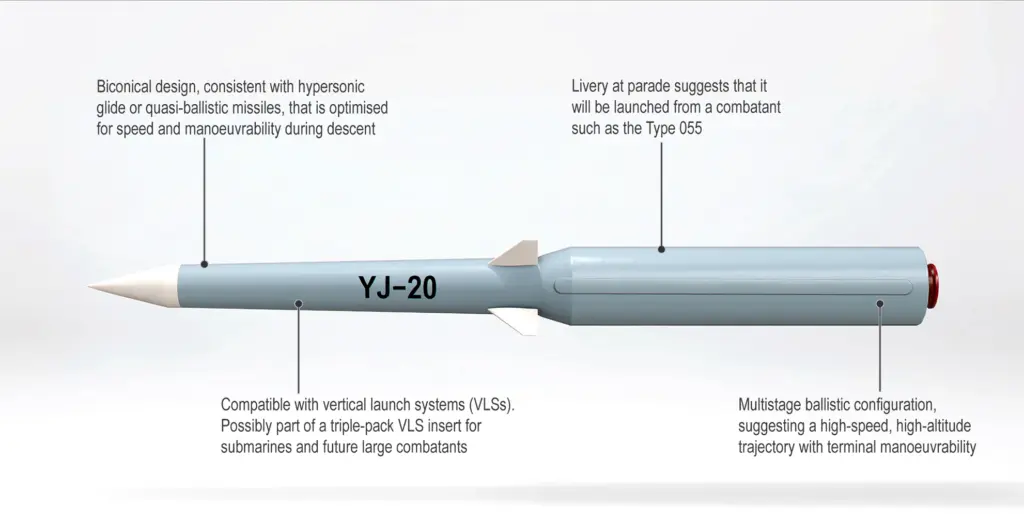
Another new missile revealed at the parade was the YJ-20, which appears to combine advanced aerodynamics, hypersonic propulsion, and precision guidance capabilities.
It features a biconical design, and this suggests a multistage configuration compatible with VLSs on major surface combatants such as the Type 055 destroyer.
While official specifications are undisclosed, assessments indicate a large missile with substantial payload capacity, indicating a role as a strategic asset in China’s naval arsenal. It has an overall length between 8 and 10 m and a diameter between 80 and 120 cm.
In terms of its propulsion system, the YJ-20 likely employs a solid rocket booster for initial acceleration, transitioning to a scramjet engine for sustained hypersonic cruise.
Given this propulsion configuration and its form factor, the estimated speed of the YJ-20 likely lies between Mach 6 and Mach 7 during cruise, with terminal velocities potentially reaching Mach 9.
This performance, coupled with an estimated operational range between 1,500 and 2,000 km, enables deep strike capability across the Indo-Pacific theatre.
The weapon’s guidance likely consists of an integration of BeiDou satellite-based navigation systems, active radar homing, and imaging infrared seekers, ensuring resilience against electronic countermeasures and precision targeting of high-value assets.
With these characteristics, the YJ-20 will be a cornerstone of China’s A2/AD doctrine given its ability to penetrate layered defences and deliver kinetic energy at hypersonic speeds, making it exceptionally difficult to intercept with current missile defence systems.
The YJ-20 will also play a large part in the PLAN’s strategy to counter aircraft carriers in the region, underscoring the service’s long-held ambition to alter the regional balance of power by challenging US and allied naval dominance.