China has recently revealed a wave of new military aviation systems, signalling a rapid acceleration in the modernisation of the People’s Liberation Army (PLA). Beginning with the 3 September military parade marking the 80th anniversary of the end of the Second World War, Beijing showcased several previously undisclosed aircraft programmes, while also confirming the operational status of platforms that had been under development for years.
These announcements highlight China’s push to strengthen core air–combat capabilities as part of its broader military roadmap. The PLA aims to achieve major modernisation milestones by 2027, coinciding with its 100th anniversary, and reach a more complete transformation by 2035. Both goals serve as stepping stones toward Beijing’s longer-term ambition of building a “world-class military” by 2049, the centenary of the People’s Republic of China.
As part of this drive, the parade featured nine newly fielded manned aircraft, underscoring the depth and speed of China’s aviation progress. Among the most notable platforms were next-generation designs such as the single-seat, twin-engine J-35A fifth-generation fighter for the PLAAF and its carrier-capable variant for the PLA Navy. China also publicly demonstrated the J-20S, a twin-seat evolution of its flagship stealth fighter, developed to enhance mission flexibility and support roles after more than seven years of testing.
Several other aircraft of a more conventional configuration also made their debut. These included an armed version of the Z-20 utility helicopter, demonstrating the platform’s transition into a multirole battlefield asset, and three newly operational Y-20B strategic transport aircraft, now powered by the domestically produced WS20 engine instead of Russian imports—an important step toward aviation self-reliance.
China additionally highlighted four new special-mission aircraft, reflecting investment in airborne command-and-control and maritime support capabilities. Chief among them was the KJ-600 ‘Sea Plate’ AEW&C aircraft, a carrier-based early warning platform expected to operate from the PLAN’s third aircraft carrier, Fujian (CV-18), which features an electromagnetic launch system that enables fixed-wing surveillance aircraft to take off at sea.
Collectively, these advancements illustrate China’s effort to enhance long-range power projection, strengthen maritime situational awareness, and build a more versatile air combat force. The breadth of new systems suggests that China is not only pursuing stealth fighters but also developing the supporting aircraft needed for integrated, multi-domain operations.
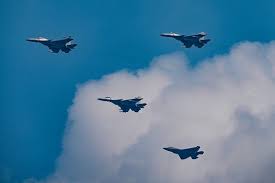
New naval fighter aircraft, including one Shenyang J-15DT EW aircraft (far left), two J-15Ts, and a single J-35 naval variant (bottom right), fly over Beijing on 3 September 2025.
China further demonstrated the pace of its air-combat modernisation by revealing seven new categories of unmanned aerial vehicles (UAVs) during the parade. These systems highlight Beijing’s rapid progress in autonomous aviation and its growing commitment to integrating unmanned platforms into frontline operations.
Among the newly displayed drones were collaborative combat aircraft (CCAs) designed to operate alongside manned fighter jets, as well as multirole UAVs capable of intelligence gathering, surveillance, reconnaissance, precision strikes, and electronic warfare. Their appearance reflects China’s increasing reliance on AI-enabled systems to enhance the effectiveness and survivability of its air assets.
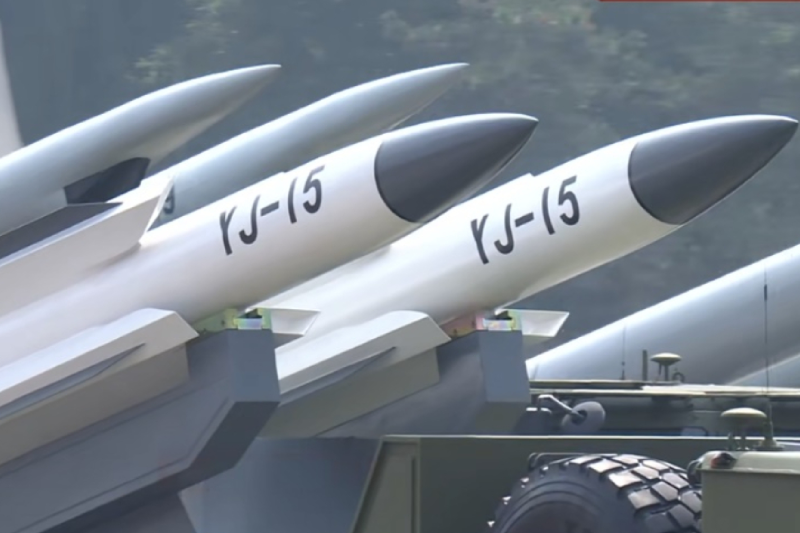
China also introduced three new air-launched missiles and a modern electronic-warfare pod for UAVs, signalling a broader effort to diversify and upgrade the country’s airborne strike and support capabilities.
A spokesperson for China’s Ministry of National Defense stated on 10 September that the newly showcased equipment represents “the latest direction of modern warfare,” emphasising China’s strengthened system-wide combat readiness, improved capabilities in emerging domains, and enhanced strategic deterrence. The spokesperson reiterated that China maintains a defensive military posture but believes that strong preparedness is essential for preventing conflict.
Earlier, on 20 August, the State Council Information Office noted that all systems featured in the parade were active, domestically produced platforms currently in service with the PLA. The office added that several of these assets were being presented to the public for the first time, reflecting significant progress in China’s pursuit of advanced air-combat capabilities.
Confirming their operational status, the PLA released footage on 22 September showing multiple platforms—such as the KJ-600 carrier-based early-warning aircraft, the J-35 naval stealth fighter, and the J-15T—conducting launch and recovery operations from China’s newest aircraft carrier, Fujian. These demonstrations indicate that the showcased aircraft are not only developed but are beginning to enter active deployment.
Loyal wingmen
China’s latest military parade highlighted a new generation of unmanned aerial systems, confirming that several advanced UAV programs are now being integrated into specialised units of the PLA Air Force (PLAAF) and PLA Navy (PLAN). Their introduction reflects China’s drive to strengthen intelligence gathering, surveillance, and command-and-control capabilities as part of an expanding shift toward high-tech, network-centric warfare.
An article published on 3 September in the state-run Guangming Daily noted that unmanned platforms supported by artificial intelligence, fast data-link connectivity, and autonomous decision-making will help transition the PLA toward a more automated combat structure. According to two scholars from the PLA Ground Force Command College, such technologies will lower risks for human pilots while allowing unmanned aircraft to tackle complex missions with greater situational awareness and quicker reaction cycles.
During the parade, four newly developed UAVs drew significant attention. Chinese announcers described them as “loyal wingmen,” designed to fly alongside manned fighter aircraft as collaborative combat aircraft (CCAs). All four systems carried serial numbers consistent with those used by a UAV brigade based at Hotan Airbase in Xinjiang—a site widely viewed as a testing hub for China’s next-generation unmanned aircraft.
Hotan Airbase has long been associated with experimental UAV activities. Imagery of the area shows a purpose-built unmanned testing zone near the southeastern end of the runway. While the exact designation of the UAV unit has not been publicly disclosed, its operations suggest direct reporting to China’s Central Military Commission rather than to regional theatre commands—an indication of the strategic importance of the programs conducted there.
Among the newly revealed CCAs, two featured tailless configurations that state media promoted as high-performance “unmanned air-dominance aircraft.” These single-engine designs include moving wingtips and internal weapon bays, pointing toward stealth optimisation and potential strike applications. Although they share common design elements, the airframes vary in size and structure, implying that both are prototypes undergoing evaluation ahead of possible frontline selection.
One aircraft gained particular attention due to its visible serial number, 53636, linking it to the UAV unit affiliated with Hotan Airbase. While no official designation has been released, the aircraft’s appearance suggests it is part of a broader effort to introduce autonomous wingmen able to support fighter missions, conduct independent precision strikes, and expand China’s air-combat options in future conflict scenarios.
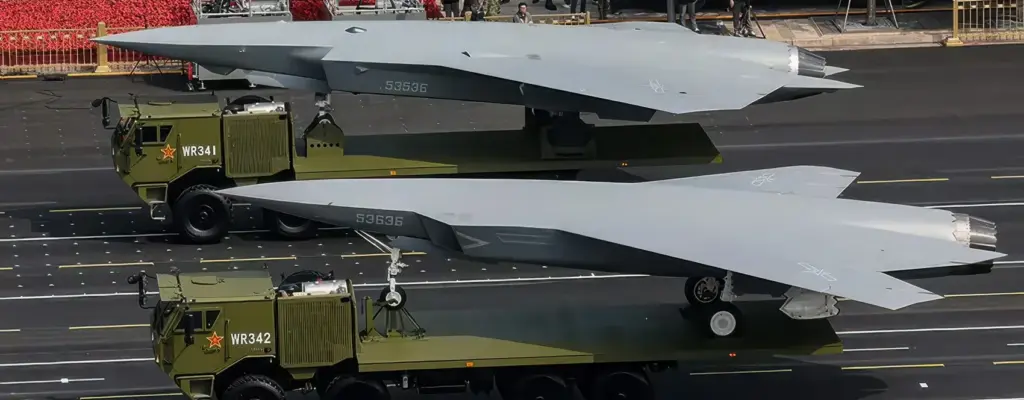
One of the newly revealed unmanned combat aircraft, informally referred to as CCA 3, features a distinctive configuration that includes lambda-shaped wings and two caret-shaped engine intakes fitted with splitter plates. The aircraft also appears to incorporate foldable wings, suggesting a possible role in naval aviation. However, it lacks several features typically associated with carrier-based aircraft, such as twin-wheel landing gear, reinforced undercarriage structures, and a tail hook. This indicates that while the design may support maritime operations, it is likely not intended for routine carrier take-off and recovery.
CCA 3 also shows signs of internal bays along the sides of the fuselage. While these structures are consistent with internal weapon storage, their exact function has not been officially confirmed and may include additional payload or sensor compartments.
A second unmanned combat aircraft, referred to here as CCA 4, carried a serial number closely aligned with that of CCA 3, suggesting that both platforms are linked to the same unidentified UAV unit operating from Hotan Airbase. In terms of size, CCA 4 is estimated to be longer—around 18 metres in length—while having a slightly smaller wingspan of approximately 11.7 metres, compared to CCA 3’s near-13-metre span.
CCA 4 differs significantly in its overall design. It features diamond-shaped wings, forward-angled engine intakes equipped with diverterless supersonic inlet (DSI) bumps, and an electro-optical targeting system mounted beneath the nose. Additional survivability features appear to include laser warning sensors positioned on the outer sides of both engine intakes, along with a small infrared or laser aperture located on the upper left section of the nose.
The landing gear configuration of CCA 4 also appears distinct. Its rear landing gear bay extends longitudinally along the fuselage, whereas CCA 3’s rear landing gear seems to retract into the lower wing structure. These differences suggest that the two aircraft are being evaluated for different operational concepts or mission profiles.
In addition to these two tailless platforms, two other combat-oriented UAVs were displayed. These aircraft are also single-engine designs but are smaller in size than the tailless CCAs. Despite their reduced dimensions, all four unmanned combat aircraft appear to incorporate internal weapon bays, reinforcing their intended role as stealth-oriented strike and support platforms.
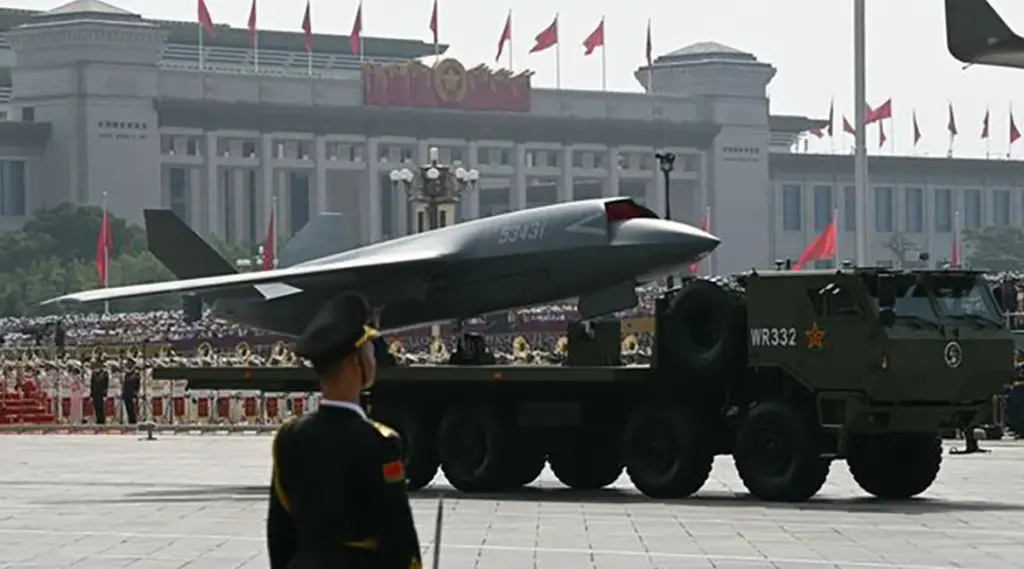
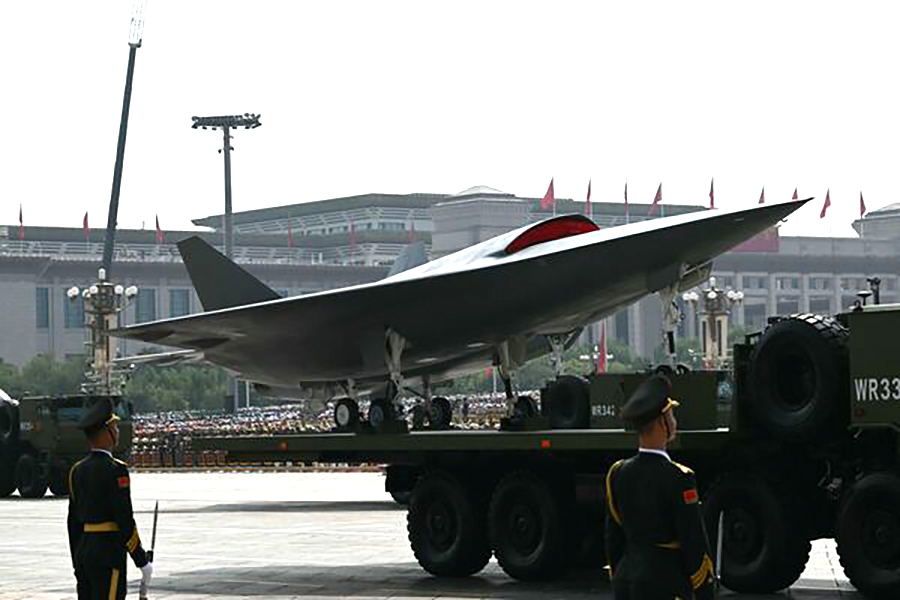
Among the smaller unmanned combat aircraft displayed, one platform—referred to here as CCA 1—shares notable design similarities with Western loyal wingman concepts. Its configuration includes swept wings and outward-canted tailfins, optimised for stability and reduced radar signature. A key distinguishing feature is its dorsal engine intake, which is positioned further forward along the upper fuselage, a layout that may improve airflow management while supporting stealth-oriented shaping.
The second small unmanned combat aircraft, referred to as CCA 2, adopts a different aerodynamic approach. It is equipped with diamond-shaped wings, canted tailfins, and a dorsal engine intake located closer to the central section of the fuselage. This configuration suggests an emphasis on balanced lift, manoeuvrability, and low observability across multiple flight regimes.
A visible serial number, 53431, links CCA 2 to the same UAV unit operating from Hotan Airbase, reinforcing the assessment that these aircraft are part of a coordinated testing and evaluation programme. Although smaller than the tailless CCAs revealed at the parade, both CCA 1 and CCA 2 appear to be designed for frontline support roles, likely operating alongside manned fighters in reconnaissance, strike support, or electronic warfare missions.
According to Bai and Xie, China’s development of unmanned systems across air, land, and sea domains will “strengthen the PLA’s offensive and defensive deployment methods such as information fusion and utilisation, and heterogeneous unmanned swarms”.
Naval Airpower
Although China formally presented the Shenyang J-35 stealth fighter at Airshow China in November 2024, its appearance at the 3 September military parade provided stronger evidence that the aircraft has now entered active service. During the event, three land-based J-35A fighters and at least one carrier-capable naval variant were displayed wearing PLA markings and serial numbers, indicating operational induction.
The naval version of the J-35 differs from the PLAAF’s land-based J-35A in several key design aspects. It features a larger wing chord, with the trailing edge extending closer to the leading edge of the tailplane. This configuration is likely intended to improve lift and handling during carrier landings. The wing design also suggests the use of extended flaps and aileron droop in landing mode, which enhances low-speed control during carrier recovery operations.
To support sustained naval operations, the aircraft’s airframe and engine components are expected to be treated with specialised anti-corrosion coatings. These measures are essential for operating in harsh maritime environments, where exposure to saltwater and humidity can degrade structural and engine performance over time.
In October 2025, Sun Cong, the chief designer of the J-35, stated in an interview with state broadcaster CCTV that the naval variant incorporates a dual-mode take-off system. This system allows the aircraft to operate from aircraft carriers equipped with either catapult launch systems or ski-jump ramps, significantly expanding its deployment flexibility across China’s current and future carrier fleet.